Tauro Fútbol Club are the most successful team in Panamanian league history, with nine wins and eight runners up gongs under their belts since their relatively recent foundation in 1984. Like many other stripes around the world, they are believed to have chosen their strip because their founder, Italian industrialist Giancarlo Gronchi was a fan of some mob from his homeland called Juventus.
They play in the slightly obtuse Liga Panameña de Fútbol, where like an increasing amount of countries in Latin America the season is split into two tournaments - the Apertura and Clausura. Both of these have two stages - a round robin league where everybody plays everybody else, followed by a knockout where the top four team have a series of play-offs to decide the winner.
Relegation is decided by adding both sets of round- robin tables, and the winners of both halves of the season qualify for the CONCACAF Champions League. And you thought our play-off systems were tricky to fathom! Prior to the creation of the main national league, Tauro played in the Liga Distritorial de Chepo, a league for clubs from the Eastern side of the country.
Interest in football comes a distant second in a country obsessed by baseball, and so Tauro's achievements in becoming the most popular club in Panama and begining to bring the game to the masses is even more remarkable.
They have a great rivalry with their fellow Panama City club Plaza Amador, their matches known locally as El Clásico. This dates back to the very first match in the LPF where Tuaro's Carlos Maldonado scored the debut goal in the competition's history. Current stars include captain Luis Moreno, a much capped Panamanian international, Colombia journeyman Joan Melo and Argentinian strike man Matias Bernal. The team are also notable for having kept the same manager, Uruguayan Miguel Mansilla, for over 20 years - a feat almost unheard of in the volatile world of Central American football.
All photos © lays with the owners
Videos from YouTube. Underlying © lays with the owners of the clips.
Monday, May 3, 2010
St Mirren (Scotland)
Formed as a gentlemen's club in Paisley way back in the Victorian mists of 1877, St Mirren can rightly be described as one of the most historic teams in Scottish football. One of only five remaining clubs from the foundation of the Scottish League in 1890, they played one of the first night games in history that same year when Morton's ground was lit by gaslamps. They are named after St Mirin of Benchor, an Irish monk and missionary who was the founder of Paisley Abbey in the sixth century, and wenty on to become the town's patron saint.
There is some dispute as to why they play in the glorious black and white. Some say that the colours come from the black and white tiles that mark the floors of all Masonic lodges, others that it refers to the black and white river carts that run through Paisley. But the most likely, and more prosaic answer is that they just liked the look of Notts County's strip.
They played at their famous and evocative Love Street ground between 1894 and 2009, the stadium seeing their record, pre-health and safety attendance of 47,438 for a game against Celtic in 1949. However, in 2005 they decided to move away from their historic base and move to a new purpose-built stadium to help clear their significant debts. The last match to be played at Love Street was a goalless draw against Motherwell on 3 January 2009 - a highly emotional afternoon before a sell out crowd.
Their next home game a couple of weeks later was at the newly built St Mirren Park, an 8,000 capacity identikit stadium, not far from their old home, opened by Scottish First Minister Alex Salmond on 31 January. The first match, against Kilmarnock, finished in a 1-1 draw, the first goal scored by the Killies' Kevin Kyle.
As far as results go, they've won the Scottish Cup on three occasions, in 1926, 1959 and 1987, and have a long history in Scotland's top flight, their best finish being when they came in third behind Aberdeen and Celtic in 1980. They are also the only Scottish club to have ever won the Anglo-Scottish Cup, beating Bristol City in a two-legged final in their glory season of 1980.
They are perhaps most notable though as being the only club to have ever sacked Sir Alex Ferguson. In his second managerial position, after a brief stint at East Stirlingshire, he took the club from being a lower second division outfit with meagre crowds upon his appointment in 1974, to first division champs in 1977. And starting a theme that would stick with him to his Manchester United days, he won it with kids - the average age of his winning squad being a baby-faced 19 years. Little is known of the exact reason for his dismissal, but stories abound of his unreasonable behaviour to club staff and his being tapped up by Aberdeen for their managerial job.
But I'm sure The Buddies, as they are quaintly known, would much prefer to be remembered for their football and their long, proud history than some grumpy old bloke who briefly passed through their gates - and long may they honor their colours!
All photos © lays with the owners
Videos from YouTube. Underlying © lays with the owners of the clips.
There is some dispute as to why they play in the glorious black and white. Some say that the colours come from the black and white tiles that mark the floors of all Masonic lodges, others that it refers to the black and white river carts that run through Paisley. But the most likely, and more prosaic answer is that they just liked the look of Notts County's strip.
They played at their famous and evocative Love Street ground between 1894 and 2009, the stadium seeing their record, pre-health and safety attendance of 47,438 for a game against Celtic in 1949. However, in 2005 they decided to move away from their historic base and move to a new purpose-built stadium to help clear their significant debts. The last match to be played at Love Street was a goalless draw against Motherwell on 3 January 2009 - a highly emotional afternoon before a sell out crowd.
Their next home game a couple of weeks later was at the newly built St Mirren Park, an 8,000 capacity identikit stadium, not far from their old home, opened by Scottish First Minister Alex Salmond on 31 January. The first match, against Kilmarnock, finished in a 1-1 draw, the first goal scored by the Killies' Kevin Kyle.As far as results go, they've won the Scottish Cup on three occasions, in 1926, 1959 and 1987, and have a long history in Scotland's top flight, their best finish being when they came in third behind Aberdeen and Celtic in 1980. They are also the only Scottish club to have ever won the Anglo-Scottish Cup, beating Bristol City in a two-legged final in their glory season of 1980.
They are perhaps most notable though as being the only club to have ever sacked Sir Alex Ferguson. In his second managerial position, after a brief stint at East Stirlingshire, he took the club from being a lower second division outfit with meagre crowds upon his appointment in 1974, to first division champs in 1977. And starting a theme that would stick with him to his Manchester United days, he won it with kids - the average age of his winning squad being a baby-faced 19 years. Little is known of the exact reason for his dismissal, but stories abound of his unreasonable behaviour to club staff and his being tapped up by Aberdeen for their managerial job.
But I'm sure The Buddies, as they are quaintly known, would much prefer to be remembered for their football and their long, proud history than some grumpy old bloke who briefly passed through their gates - and long may they honor their colours!
All photos © lays with the owners
Videos from YouTube. Underlying © lays with the owners of the clips.
Sunday, May 2, 2010
Tvøroyrar Bóltfelag (Faeroe Islands)
The oldest club in the Faeroes, and the ninth most senior in Denmark, of who the Faeroes are still officially a part, Tvøroyrar Bóltfelag are thankfully, as is the tradition with the long and unpronouncable names of clubs from those Islands, more commonly known as TB. Founded way back in 1892, they're based in the Faeroese town of Tvøroyri - although town is perhaps pushing it a bit, as its population was a roomy 1785 at the last census back in 2008.
Tvøroyri lies on the north side of the picturesque Trongisvágsfjørður on the country's Southern-most island of Suðuroy, some two hours by ferry from the capital Tórshavn, and as such their snug 4000 capacity Sevmýri ground must hold claim to being one of the most remote grounds in a major European league. But the long trip would be worth it, as the surrounding scenery is just startling!
Winners of the Faeroe Islands Premier League eight times, they've recently slipped into the second tier, where they narrowly missed out on promotion back to the top flight in each of the last three seasons. There is however talk of merging Suðuroy's other two significant teams together, following TB's slide into the second level. Fans of TB, the recently formed FC Suðuroy - already subject of a merger between VB Vágur and Sumba - as well as third division outfit Royn Hvalba are rightfully up in arms about it all. Surely a side as historic as TB should be allowed to keep its identity, whatever its league position - and at the very least, it would be a crime if its famous black and white stripes were no longer seen on their beautiful island.
All photos © lays with the owners
Videos from YouTube. Underlying © lays with the owners of the clips.
Tvøroyri lies on the north side of the picturesque Trongisvágsfjørður on the country's Southern-most island of Suðuroy, some two hours by ferry from the capital Tórshavn, and as such their snug 4000 capacity Sevmýri ground must hold claim to being one of the most remote grounds in a major European league. But the long trip would be worth it, as the surrounding scenery is just startling!
Winners of the Faeroe Islands Premier League eight times, they've recently slipped into the second tier, where they narrowly missed out on promotion back to the top flight in each of the last three seasons. There is however talk of merging Suðuroy's other two significant teams together, following TB's slide into the second level. Fans of TB, the recently formed FC Suðuroy - already subject of a merger between VB Vágur and Sumba - as well as third division outfit Royn Hvalba are rightfully up in arms about it all. Surely a side as historic as TB should be allowed to keep its identity, whatever its league position - and at the very least, it would be a crime if its famous black and white stripes were no longer seen on their beautiful island.
All photos © lays with the owners
Videos from YouTube. Underlying © lays with the owners of the clips.
Adelaide City (Australia)
Australia is known throughout the world as a passionate and proud sporting nation. But little is known of their club football outside their shores. Indeed, all we in the UK used to know of their domestic leagues was as part of the close season Summer football pools coupons. But many of those names that we hoped would manage a score draw and help bag us a moderate fortune have long and proud histories - and few better than The Mighty Zebras of Adelaide City.
Formed in 1946 as many Aussie clubs were by a group of Adelaide residents of Italian heritage, the team were originally called simply Juventus, before extending it to Adelaide Juventus in the mid sixties. Eleven years later they changed again to Adelaide City, finally losing their link to the Italian favourites, but keeping the black and white kit all the same. They are currently among the tops sides in the regional South Australian Super League, although they spent many seasons in the old National Soccer League, winning the title three times before it folded in 2004.
Towards the end of their stint in the NSL they became known as Adelaide Force, when the league's sponsors were trying to rock and roll it up a bit, but reverted to City when they chose not to move into the new rebranded and highly franchised A-League. Since their reversion to the regional league they have won the title four times off the bat, but as promotion to the A-League is invitational and not automatic they have not taken their rightful place back in the top flight.
Notable former players include the one time Coventry and Portsmouth striker, John Aloisi, former Chelsea, Swindon and Millwall hitman David Mitchell and the tragic ex-Norwich star Justin Fashanu.
In their 64 year history they have won an outstanding 17 titles at the various levels they have played, and surely if it were not for the curious politics of Australian football they have reclaimed their rightful place at the top table of their national league a long time ago.
All photos © lays with the owners
Videos from YouTube. Underlying © lays with the owners of the clips.
Formed in 1946 as many Aussie clubs were by a group of Adelaide residents of Italian heritage, the team were originally called simply Juventus, before extending it to Adelaide Juventus in the mid sixties. Eleven years later they changed again to Adelaide City, finally losing their link to the Italian favourites, but keeping the black and white kit all the same. They are currently among the tops sides in the regional South Australian Super League, although they spent many seasons in the old National Soccer League, winning the title three times before it folded in 2004.
Towards the end of their stint in the NSL they became known as Adelaide Force, when the league's sponsors were trying to rock and roll it up a bit, but reverted to City when they chose not to move into the new rebranded and highly franchised A-League. Since their reversion to the regional league they have won the title four times off the bat, but as promotion to the A-League is invitational and not automatic they have not taken their rightful place back in the top flight.
Notable former players include the one time Coventry and Portsmouth striker, John Aloisi, former Chelsea, Swindon and Millwall hitman David Mitchell and the tragic ex-Norwich star Justin Fashanu.
In their 64 year history they have won an outstanding 17 titles at the various levels they have played, and surely if it were not for the curious politics of Australian football they have reclaimed their rightful place at the top table of their national league a long time ago.
All photos © lays with the owners
Videos from YouTube. Underlying © lays with the owners of the clips.
CD Nacional (Portugal)
CD Nacional are a Portuguese top flight club hailing from the remote island of Madeira, some 323 miles off the coast of Morocco. Despite being so far off the beaten track, the island is home to two clubs in their nation's first division, Nacional, and their fierce rivals Marítimo, also from Funchal. Despite their formation in 1910, Nacional only reached the highest league in 1989. In recent years though they've become a firm fixture in the league, finishing an impressive fourth on a couple of occasions.
Being only an hour and a half's flight from Lisbon, Funchal popular location for away fans, and their recently expanded Estádio da Madeira ground nestles in the plush wooded foothills of the mountains that surround the city. Their recent success has seen them reach the UEFA cup and its successor the Europa League on three occasions now, although their only significant success in these competitions was when they beat former holders Zenit Saint Petersburg in the knockout stages in August 2009.
Their ground, also known as the Choupana, holds a cosy 5132, despite its recent upgrading, and is unusual in that it has no stands behind its goals, favouring instead a big fence and some smashing views of the surrounding area. As you would expect with both teams coming from such a small island, their derby with Marítimo is a particularly rabid one, with a huge socio-political divide between supporters of the two clubs that practically divides the island. The more middle-class and upwardly mobile Nacional fans were in favour of the commercial expansion of Madeira while the more working class Marítimo wanted to preserve the land and culture of the island. As you would imagine, this has caused even more ill-feeling between between the two already diametrically opposed sets of fans in a passionate country.
Perhaps Nacional's most famous son is a local lad you may just have heard of called Cristiano Ronaldo. After starting out in the youth team of local amateur side Andorinha, he moved to Nacional in 1997, where he caused such a stir in his immediately pre-teenage years that Sporting Lisbon snapped him up as a twelve-year-old. I believe you probably know the rest of the story. So proud of their former youth star are they that they have named their academy campus after him.
They may be an unassuming club with a tiddly ground in an out-of-the-way location, but these Madeirans are a passionate breed, and harbour ambitions for bigger and better things.
All photos © lays with the owners
Videos from YouTube. Underlying © lays with the owners of the clips.
Being only an hour and a half's flight from Lisbon, Funchal popular location for away fans, and their recently expanded Estádio da Madeira ground nestles in the plush wooded foothills of the mountains that surround the city. Their recent success has seen them reach the UEFA cup and its successor the Europa League on three occasions now, although their only significant success in these competitions was when they beat former holders Zenit Saint Petersburg in the knockout stages in August 2009.
Their ground, also known as the Choupana, holds a cosy 5132, despite its recent upgrading, and is unusual in that it has no stands behind its goals, favouring instead a big fence and some smashing views of the surrounding area. As you would expect with both teams coming from such a small island, their derby with Marítimo is a particularly rabid one, with a huge socio-political divide between supporters of the two clubs that practically divides the island. The more middle-class and upwardly mobile Nacional fans were in favour of the commercial expansion of Madeira while the more working class Marítimo wanted to preserve the land and culture of the island. As you would imagine, this has caused even more ill-feeling between between the two already diametrically opposed sets of fans in a passionate country.
Perhaps Nacional's most famous son is a local lad you may just have heard of called Cristiano Ronaldo. After starting out in the youth team of local amateur side Andorinha, he moved to Nacional in 1997, where he caused such a stir in his immediately pre-teenage years that Sporting Lisbon snapped him up as a twelve-year-old. I believe you probably know the rest of the story. So proud of their former youth star are they that they have named their academy campus after him.
They may be an unassuming club with a tiddly ground in an out-of-the-way location, but these Madeirans are a passionate breed, and harbour ambitions for bigger and better things.
All photos © lays with the owners
Videos from YouTube. Underlying © lays with the owners of the clips.
Montevideo Wanderers (Uruguay)
Wanderers are something of a phenomenon in Uruguayan football - but not always necessarily for the stuff that happens on the pitch. Although they can trace their history back to a small student team back as far as 1898, they formally formed four years later in 1902, immediately causing a stir. This was arguably the most successful period of their history, as they won the league in 1906 and 1908, plus the Copa de Honor in 1908 and 1910, as well as a clutch of smaller local and international tournaments.
To this day they are one of only three clubs to have won the title unbeaten - the other pair being Club Nacional de Fútbol and Club Atlético Peñarol - known locally as The Two Bigs, the Uruguayan version of The Old Firm. They gained their name of Wanderers after the club's founders, the Sardeson Brothers, travelled to England and were excited to discover that Wolverhampton Wanderers has won the FA Cup. As they had no official kit, money or even a ground they felt that the description Wanderers suited them perfectly, so took it home with them for their fledgling club as a homage to Wolves.
They continued to be one of their country's top teams, frequently touring outside of their country, until a financial crisis in the 1940s saw them sell all their biggest names, and since then they have struggled to remain competitive against the richer teams. They subsequently became a battling yo-yo club of some repute, winning the Segunda División Uruguay on four occasions. The mid-1990s saw them nearly go out of business, but their fortunes have seen an upswell in recent years. If they had gone to the wall though football would have lost one of its most lively sets of fans - Los Vagabundos.
Their Estadio Viera ground may not be the largest or most well kept in their league, but it's certainly one of the most atmospheric. Surrounded by plush parkland, and fringed by exotic vegetation that overhangs the open seating, the ground is a perfect stage for the lively Wanderers fans. Home games are a riot of flags and banners, will reems of streamers being thrown from the off, and full salsa bands playing for the whole game. The fans themseleves often arrive clutching their trademark black and white umbrellas, and are famed throughout South America as being one of the biggest party mobs on the continent.
And just lately they've had something to cheer about. Since they last found their way back to the top flight in 2000, they've been gradually consolidating, finishing fourth in the table last term. A club with that kind of loyal fanbase deserves a bit of success, so let's hope they soon return to the glory days.
All photos © lays with the owners
Videos from YouTube. Underlying © lays with the owners of the clips.
To this day they are one of only three clubs to have won the title unbeaten - the other pair being Club Nacional de Fútbol and Club Atlético Peñarol - known locally as The Two Bigs, the Uruguayan version of The Old Firm. They gained their name of Wanderers after the club's founders, the Sardeson Brothers, travelled to England and were excited to discover that Wolverhampton Wanderers has won the FA Cup. As they had no official kit, money or even a ground they felt that the description Wanderers suited them perfectly, so took it home with them for their fledgling club as a homage to Wolves.They continued to be one of their country's top teams, frequently touring outside of their country, until a financial crisis in the 1940s saw them sell all their biggest names, and since then they have struggled to remain competitive against the richer teams. They subsequently became a battling yo-yo club of some repute, winning the Segunda División Uruguay on four occasions. The mid-1990s saw them nearly go out of business, but their fortunes have seen an upswell in recent years. If they had gone to the wall though football would have lost one of its most lively sets of fans - Los Vagabundos.
Their Estadio Viera ground may not be the largest or most well kept in their league, but it's certainly one of the most atmospheric. Surrounded by plush parkland, and fringed by exotic vegetation that overhangs the open seating, the ground is a perfect stage for the lively Wanderers fans. Home games are a riot of flags and banners, will reems of streamers being thrown from the off, and full salsa bands playing for the whole game. The fans themseleves often arrive clutching their trademark black and white umbrellas, and are famed throughout South America as being one of the biggest party mobs on the continent.
And just lately they've had something to cheer about. Since they last found their way back to the top flight in 2000, they've been gradually consolidating, finishing fourth in the table last term. A club with that kind of loyal fanbase deserves a bit of success, so let's hope they soon return to the glory days.
All photos © lays with the owners
Videos from YouTube. Underlying © lays with the owners of the clips.
Labels:
Club Atlético Peñarol,
Club Nacional de Fútbol,
Copa de Honor,
Estadio Viera,
Football,
Los Vagabundos,
Montevideo Wanderers,
Nacional,
Peñarol,
The Two Bigs,
Uruguay,
Wanderers,
Wolves
Saturday, May 1, 2010
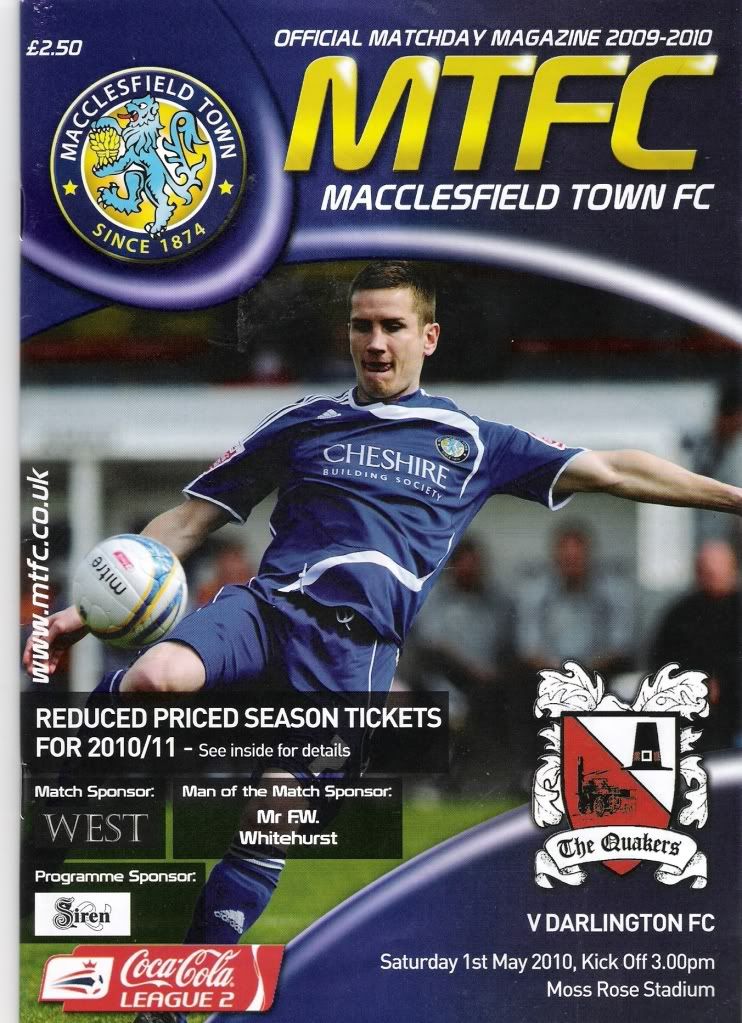
My Matchday - 251 Moss Rose
Macclesfield Town 0v2 Darlington
League Two
Saturday 1st May 2010

Macclesfield is a market town in the east of Cheshire on the River Bollin, located close to the county borders of Greater Manchester, Derbyshire and Staffordshire.
Macclesfield is know as the “Silk Town” as it was once the worlds biggest producer of finished silk but it is also nicknamed “Treacle Town” The treacle link is believed to come from an incident when a wagon overturned spilling a load of treacle on Hibel Road, the town folk rushed out to scoop the treacle off the cobbled street into jugs and bowls. Another treacle explanation is that mill-owners used to provide barrels of the brown sweet sticky liquid to the unemployed weavers.
I’ve always known the town as “Macc” due to the infamous local punk/rock ban
d The Macc Lads, the self acclaimed " rudest, crudest, lewdest, drunkest band in Christendom",
If your unaware of The Macc Lads music, I would describe them as rude, filthy, sexist, homophobic and politically incorrectable, but they do bang out one hell of a cracking tune! Their lyrics mainly involve around pulling crack(women) chips and gravy and drinking lots of beer, particularly Boddingtons Bitter (Boddies) as in one memorable lyric from Barrel’s Round “You've got veins in your bodies but we've got Boddies in our veins, we‘ll out drink anybody then we‘ll go and do it all again”
The beauty(or curse)of www. is the possibility to reunite with lost friends and family. So with special thanks to Pete’s ex-wife Anne I was delighted to receive an email on Friday night from Pete, arranging to meet up in Macclesfield for - as The Macc Lads would graciously express it “Give me alcohol, Give me alcohol, Don't want a pie or a cornish pasty, Give us a pint or I'll turn nasty, Gimme gimme gimme gimme gimme gimme alcohol”
After catching my train connection from Manchester I arrived in town at 12.45. I headed straight to the GBG recommended Market Green Tavern, before meeting Pete (after a bit of a mix up) in the Society Rooms Wetherspoons pub. It was great to catch up after all these years for a bevvy and hopefully we’ll meet again next time I’m in the north west. Unfortunately there was no “Boddies” to be had, but some great ales in the pubs and especially the Nags Head after the game.
Macclesfield originated from a rugby club in 1874 and began playing in The Combination league at Moss Rose from 1891. The original club went bankrupt in 1897, so Hallfield FC took over the ground, subsequently taking over the town’s name in 1904 and later joined the Lancashire Combination League.
Moss Rose first major work came in 1906 with the construction of a timber main stand with cover added on the opposite terrace and a dressing room block situated in the pub corner of the ground.
The Silkmen became founder members of the Cheshire County League in 1919, winning the first of six titles in 1932 with further honours in the League and Senior cup competitions. It was in the Cheshire Senior Cup which produced the grounds biggest attendance of 9,003 on February 4th 1948 for a 2nd Round tie with Winsford United.
The club had the Town suffix added in 1966 and one year earlier the ground’s first floodlights were installed, switched on for a fixture with Northwich Victoria which attracted a crowd of 3,200.
The old grandstand was replaced in 1968 as the club became founder members of the Northern Premier League after winning their final Cheshire League title. The club became inaugural winners of the league, then the following season they retained the title and added another first to the record books, as FA Trophy winners at Wembley in 1970. The club are currently celebrating the 40th anniversary of being the first winners of the competition, honouring which is regarded as The Silkmen’s greatest ever side.
Promotion to the Conference was achieved after winning their third NPL title in 1986-87, but further promotion to the Football League was denied when winning the league in 1994-95 due to ground grading guidelines. The only work undertaking during this period was new offices, changing rooms and in 1988 the grass banking was replaced with terracing behind one goal and around the stand, also a new Social Club was opened in 1990.
Moss Rose was deemed fit for League football only three years earlier after only minor alterations allowed Chester City (RIP) to ground share after vacating Sealand Road, while the Deva Stadium was under construction. However new tighter ground grading rules meant Macc had to wait another two years, after securing a second Conference title, following on from a second successful trip to Wembley the previous year.
Macclesfield Town hosted League Football for the first time with a 2-1 win over Torquay United in August 1997, a season which concluded with instant success as runners-up and promotion to the third tier of English football.
The Silkmen were relegated the following season but have managed to maintain their League Two status, even though it’s been an annual struggle to survive.
In February 2008 Keith Alexander replaced Ian Brightwell as boss until the end of the season, steering the club clear of the drop with four wins and three draws in the nine remaining games and was rewarded with a 2 year contract.
Keith Alexander suffered a double brain aneurysm in 2003 when manager of Lincoln City.On 2nd March 2010 Keith arriving home from the League Two match at Notts County feeling unwell, he collapsed and was taking to Lincoln Hospital where he died shortly afterwards at the age of 53.
The club and team responded positively to such tragic circumstances, winning what would have been Keith’s 100th game in charge at Hereford the following Saturday and have continued to pull together with a string of good results, which is an honour to his memory and which would have made “the gaffer” proud.

This season Town have had a stress free end of the season as far as flirtation with the bottom two is concerned, while opponents Darlington have remained as the strongest club in the Football League (as they hold the rest up…Eddy) staying rock bottom throughout the campaign, but surprisingly relegation was only just officially confirmed in their recent away fixture at Rochdale.
It was the visitors who won the game at a canter in a typical end of season game, a headed goal in each half and even a missed penalty didn’t but a dent on such a confident performance.
Darlington took the lead in the ninth minute, a free kick from the right was headed home by skipper Miller via the underside of the bar.
The best Macc-attack in the first half came just before the break, a Tipton cross was met by a powerful header from Brown who should have done better from close range.
Darlo had a chance to double their lead early in the second half after a soft foul on Mulligan gave Convery a chance from the spot. The penalty taker tried to be clever by trying the old John Aldridge hesitant shuffle trick, but the keeper got down well to save at his left post.
Macc tried in vain the grab an equaliser, the best opportunities falling to Hessey and Sinclair but Darlington sealed their fourth away win out of the last six games when Smith got on the end of a Convery cross the round off a good days work for Darlo.
I agree with the consensus that Moss Rose still has a Non-League feel about it, but that's part of its charm. As you approach the ground from the town via London Road, you can clearly see the spectators at the back of the terrace and in the Main stand.
The Silk FM Stand has 563 red and black seats. The blue frontage roof has MFC in large white letters and the clubs lion crest. The stand has glass wind shields with terracing at each side. In the corner is a police control box with an electric scoreboard perched on top.(which on this occasion wasn’t working)
The Alfred McAlpine Stand was opened in 2001 and has a single tier of 1,550 blue seats with executive boxes running full length. The stand has a suspended TV gantry and the club shop, main offices are situated within the stand.
The Silkmen End is a bit different, a mixture of seats and terrace, five rows of blue seats with the standing area at the back. The reason for the added 486 seats was to bring the ground up to the minimum seating requirement for the Football League, with a total of 2,599 amongst the total capacity of 6,335.

The Star Lane end is a basic open terrace with blue crash barriers. Even though I have no real affection for Darlington, for photography reasons I stood on the away terrace amongst the Darlo fans.
Next season Darlington will be north east derby rivals with my non league team Gateshead in the Conference. The new rivalry seems to have already got underway with Darlo fans chanting “If your going to Gateshead clap your hands” quickly followed by “We hate Geordies and we hate Geordies” Although they did make me laugh after the official attendance of 1,716 was announced responding with “Your grounds too big for you (repeat to fade)” Well I suppose it takes one to know one!
I had an enjoyable day out in Macclesfield, which was made that extra special by meeting up with a long lost friend who I hadn’t clapped eyes on for 18 years. I suppose the only disappointment of the day was the legendary Macc Lads pub ‘The Old Bears Head’ is no more and there was no sign of Hectic House Records on Sunderland Street either. But I’ll leave it to The Macc Lads to sum up my matchday
"The weekend is coming and its time for a bath We're going to sup some Boddies and we'll have a good laugh" (I'll have to stop there, as the rest is unprintable.)
League Two
Saturday 1st May 2010
Macclesfield is a market town in the east of Cheshire on the River Bollin, located close to the county borders of Greater Manchester, Derbyshire and Staffordshire.
Macclesfield is know as the “Silk Town” as it was once the worlds biggest producer of finished silk but it is also nicknamed “Treacle Town” The treacle link is believed to come from an incident when a wagon overturned spilling a load of treacle on Hibel Road, the town folk rushed out to scoop the treacle off the cobbled street into jugs and bowls. Another treacle explanation is that mill-owners used to provide barrels of the brown sweet sticky liquid to the unemployed weavers.
I’ve always known the town as “Macc” due to the infamous local punk/rock ban
d The Macc Lads, the self acclaimed " rudest, crudest, lewdest, drunkest band in Christendom",If your unaware of The Macc Lads music, I would describe them as rude, filthy, sexist, homophobic and politically incorrectable, but they do bang out one hell of a cracking tune! Their lyrics mainly involve around pulling crack(women) chips and gravy and drinking lots of beer, particularly Boddingtons Bitter (Boddies) as in one memorable lyric from Barrel’s Round “You've got veins in your bodies but we've got Boddies in our veins, we‘ll out drink anybody then we‘ll go and do it all again”
.
The person responsible for getting me into such a vulgar band was Pete, a lad from Crewe who I met while on holiday in the Costa del Sol in 1989. We, as in ourselves and our female partners at the time stayed in touch, swapping visits between Cheshire and Tyneside over the next four years, before life changing events meant we lost touch with one another.The beauty(or curse)of www. is the possibility to reunite with lost friends and family. So with special thanks to Pete’s ex-wife Anne I was delighted to receive an email on Friday night from Pete, arranging to meet up in Macclesfield for - as The Macc Lads would graciously express it “Give me alcohol, Give me alcohol, Don't want a pie or a cornish pasty, Give us a pint or I'll turn nasty, Gimme gimme gimme gimme gimme gimme alcohol”
After catching my train connection from Manchester I arrived in town at 12.45. I headed straight to the GBG recommended Market Green Tavern, before meeting Pete (after a bit of a mix up) in the Society Rooms Wetherspoons pub. It was great to catch up after all these years for a bevvy and hopefully we’ll meet again next time I’m in the north west. Unfortunately there was no “Boddies” to be had, but some great ales in the pubs and especially the Nags Head after the game.
Moss Rose first major work came in 1906 with the construction of a timber main stand with cover added on the opposite terrace and a dressing room block situated in the pub corner of the ground.
The Silkmen became founder members of the Cheshire County League in 1919, winning the first of six titles in 1932 with further honours in the League and Senior cup competitions. It was in the Cheshire Senior Cup which produced the grounds biggest attendance of 9,003 on February 4th 1948 for a 2nd Round tie with Winsford United.
The club had the Town suffix added in 1966 and one year earlier the ground’s first floodlights were installed, switched on for a fixture with Northwich Victoria which attracted a crowd of 3,200.
The old grandstand was replaced in 1968 as the club became founder members of the Northern Premier League after winning their final Cheshire League title. The club became inaugural winners of the league, then the following season they retained the title and added another first to the record books, as FA Trophy winners at Wembley in 1970. The club are currently celebrating the 40th anniversary of being the first winners of the competition, honouring which is regarded as The Silkmen’s greatest ever side.
Promotion to the Conference was achieved after winning their third NPL title in 1986-87, but further promotion to the Football League was denied when winning the league in 1994-95 due to ground grading guidelines. The only work undertaking during this period was new offices, changing rooms and in 1988 the grass banking was replaced with terracing behind one goal and around the stand, also a new Social Club was opened in 1990.
Moss Rose was deemed fit for League football only three years earlier after only minor alterations allowed Chester City (RIP) to ground share after vacating Sealand Road, while the Deva Stadium was under construction. However new tighter ground grading rules meant Macc had to wait another two years, after securing a second Conference title, following on from a second successful trip to Wembley the previous year.
Macclesfield Town hosted League Football for the first time with a 2-1 win over Torquay United in August 1997, a season which concluded with instant success as runners-up and promotion to the third tier of English football.
The Silkmen were relegated the following season but have managed to maintain their League Two status, even though it’s been an annual struggle to survive.
In February 2008 Keith Alexander replaced Ian Brightwell as boss until the end of the season, steering the club clear of the drop with four wins and three draws in the nine remaining games and was rewarded with a 2 year contract.
Keith Alexander suffered a double brain aneurysm in 2003 when manager of Lincoln City.On 2nd March 2010 Keith arriving home from the League Two match at Notts County feeling unwell, he collapsed and was taking to Lincoln Hospital where he died shortly afterwards at the age of 53.
The club and team responded positively to such tragic circumstances, winning what would have been Keith’s 100th game in charge at Hereford the following Saturday and have continued to pull together with a string of good results, which is an honour to his memory and which would have made “the gaffer” proud.
This season Town have had a stress free end of the season as far as flirtation with the bottom two is concerned, while opponents Darlington have remained as the strongest club in the Football League (as they hold the rest up…Eddy) staying rock bottom throughout the campaign, but surprisingly relegation was only just officially confirmed in their recent away fixture at Rochdale.
It was the visitors who won the game at a canter in a typical end of season game, a headed goal in each half and even a missed penalty didn’t but a dent on such a confident performance.
Darlington took the lead in the ninth minute, a free kick from the right was headed home by skipper Miller via the underside of the bar.
The best Macc-attack in the first half came just before the break, a Tipton cross was met by a powerful header from Brown who should have done better from close range.
Darlo had a chance to double their lead early in the second half after a soft foul on Mulligan gave Convery a chance from the spot. The penalty taker tried to be clever by trying the old John Aldridge hesitant shuffle trick, but the keeper got down well to save at his left post.
Macc tried in vain the grab an equaliser, the best opportunities falling to Hessey and Sinclair but Darlington sealed their fourth away win out of the last six games when Smith got on the end of a Convery cross the round off a good days work for Darlo.
I agree with the consensus that Moss Rose still has a Non-League feel about it, but that's part of its charm. As you approach the ground from the town via London Road, you can clearly see the spectators at the back of the terrace and in the Main stand.
The Silk FM Stand has 563 red and black seats. The blue frontage roof has MFC in large white letters and the clubs lion crest. The stand has glass wind shields with terracing at each side. In the corner is a police control box with an electric scoreboard perched on top.(which on this occasion wasn’t working)
The Alfred McAlpine Stand was opened in 2001 and has a single tier of 1,550 blue seats with executive boxes running full length. The stand has a suspended TV gantry and the club shop, main offices are situated within the stand.
The Silkmen End is a bit different, a mixture of seats and terrace, five rows of blue seats with the standing area at the back. The reason for the added 486 seats was to bring the ground up to the minimum seating requirement for the Football League, with a total of 2,599 amongst the total capacity of 6,335.
The Star Lane end is a basic open terrace with blue crash barriers. Even though I have no real affection for Darlington, for photography reasons I stood on the away terrace amongst the Darlo fans.
Next season Darlington will be north east derby rivals with my non league team Gateshead in the Conference. The new rivalry seems to have already got underway with Darlo fans chanting “If your going to Gateshead clap your hands” quickly followed by “We hate Geordies and we hate Geordies” Although they did make me laugh after the official attendance of 1,716 was announced responding with “Your grounds too big for you (repeat to fade)” Well I suppose it takes one to know one!
I had an enjoyable day out in Macclesfield, which was made that extra special by meeting up with a long lost friend who I hadn’t clapped eyes on for 18 years. I suppose the only disappointment of the day was the legendary Macc Lads pub ‘The Old Bears Head’ is no more and there was no sign of Hectic House Records on Sunderland Street either. But I’ll leave it to The Macc Lads to sum up my matchday
"The weekend is coming and its time for a bath We're going to sup some Boddies and we'll have a good laugh" (I'll have to stop there, as the rest is unprintable.)
MTFC 0 DFC 2(Miller 9 Smith 78)
att.1716
Admission £14
Ground no.251 Moss Rose - Matchday Web Album(15 pictures)
Subscribe to:
Posts (Atom)