Sunday, September 5, 2010

Valestrand Hjellvik FK (Norway)

Valestrand Hjellvik are a Norwegian club from the village of Valestrandsfossen on Eye Oster - which translates roughly as Cheese Island - just North of Bergen. They were formed in 1992, when two local clubs merged. Of their constituent parts, Valestrand IF formed in 1978, and Hjellvik IL formed in 1959. Fortunately the newly merged club didn't have to spend too long thinking about a new name.


Their happy co- operation can also be seen in the club's crest, which contains the blue of Valestrand and the green of Hjellvik. Thankfully though they drew the line at chosing to play in green and blue stripes, electing instead to play in the much more elegant black and white. They play their football in the segment of the regionalised Norwegian fourth division known as the Hordaland SoccerCircle.

They play their home games at the 1000 capacity Furu Bakken Stadion, which, as is becoming a theme for this lot, translates rather cutely as Pine Hill. Since their foundation they've slowly climbed up from the sxith tier of local football, and have finished as high as third in both 2003 and 2005. And like many of the smaller Norwegian clubs, they have strong links to the community, offering a range of team from pre-school to seniors in both the men and women's game. 

All photos © lays with the owners
Videos from YouTube. Underlying © lays with the owners of the clips.

Agremiação Sportiva Arapiraquense (Brazil)

Agremiação Sportiva Arapiraquense, thankfully better known by the three letter acronym ASA, are a Brazilian fooball club from the city of Arapiraca, in Alagoas state in Brazil- known as the City of Tobacco after the principal crop in this North Eastern region. They play in the Campeonato Brasileiro Série B - the second tier of the national system - after they were promoted from Série C in 2009.

But they weren't the original football outfit in the city. They were formed in 1952 after the city's previous team, Ferroviário de Arapiraca, went under, and the city's top brass felt they needed something to keep the area in the national consciousness, and initially too the name Associação Sportiva Arapiraquense They took part in the Campeonato Alagoano - the state league of Alagoas - the following year, making the play off final. For some reason lost to history, their co-finalists refused to play them, so they were crowned champions at their first attempt, a title that they have now won six times in total.

They changed to their current, equally lengthy appelation in 1977, the Agremiação of their new name meaning College. Two years later they made it to Série A, and were nicknamed The Fantasma das Alagoas after their successful campaign. Ever since then they have used the obscure Disney character Phantom Blot as their mascot, renaming him Mancha Negra to local tastes.

They play their home games at the 10,000 capacity Municipal Coaracy da Mata Fonseca ground, and their fans prefer to go by the more formal nickname of Asa Gigante, which can mean both Giant ASA, and Giant Wing - although to be absolutely honest, I think I prefer the ghosts!

All photos © lays with the owners
Videos from YouTube. Underlying © lays with the owners of the clips.

Zebra FC (England)

If there's any club on this list who epitomise the corinthian spirit that seems to pervade the black and white colour scheme beloved by pretty much all of the teams who play in black and white stripes, it's Zebra FC. This tiny team from the Maid's Causeway area of Cambridge are a member of a tiny league well down the echelons of the Cambridgeshire FA system, but they've been doing the colours proud since at least 1993 - although no one is quite sure when they actually got going.

Originally formed as the kicky ball team for the Zebra pub smack in the middle of the city of Cambridge, the choice of colours was immediately obvious. After a while they changed their allegance to The Clarendon pub just down the road, but these days they have more of an affinity for another local establishment, The Free Press. But despite this, the colours - and the name - remain.

They call the Downing College Sports Ground their home, and they play most of their games in Division One of the rather sweetly named Cambridge and District Friendly League. The league's name originates from the days when it was formalised from a collection of teams playing friendlies against one another. Also it epitomises the League's efforts to be there more about fun and participation rather than winning at all costs.

At present their are awaiting anxiously to see if they've qualified for the C and DF League Champions Shield. This is a unique competition where the two clubs voted Most Friendly by their peers in the league are chosen to compete in the final. In theory the two bottom clubs could be voted to the final, and the organisation's champions could be the least successful in terms of results, but most popular in terms of their behaviour - both on and off the pitch. And doesn't that sound like just about the coolest competition on the planet! lets hope the Zebras do us pround and make the final!

All photos © lays with the owners
Videos from YouTube. Underlying © lays with the owners of the clips.

Saturday, September 4, 2010

My Matchday - 263 B2net Stadium

Chesterfield 2v1 Lincoln City
League Two
Saturday 4th September 2010
After last weeks visit to Morecambe, it was the turn of the other Football League club who have relocated this summer. The B2net stadium replaces the ‘classic’ Recreation Ground, the former home of The Spireites and the oldest continuous used ground dating back to 1871.

The Derbyshire market town of Chesterfield lies north of Derby on a confluence of the rivers Rother and Hipper and is the largest populated town in the county.
Chesterfield is well known for the "Crooked Spire” of the
Church of Saint Mary and All Saints, which twists at 45 degrees and leans 9 feet 6 inches from its true centre.
The spire is not attached to the church building, as it is kept on by its own weight. The bend follows the direction of the sun and it’s believed that the bend formed when the original wooden roof tiles were replaced by heavier slate and lead.


The B2net Stadium was built on the former site of Dema Glassworks, north of the town at Whittington Moor on the Sheffield Road, just off the A61.
Built at a cost of £13m by GB Building Solutions, the stadium was designed by Sheffield based Architects Ward McHugh Associates. Planning permission was granted in July 2008 and construction began in July 2009.
The official opening match was a friendly against neighbours Derby County on the 24th July 2010 with new signing Craig Davies scoring the first ever goal in a game which Derby won 5-4.

The stadium has four separate stands with an overall capacity of 10,400.
The main HTM Products Stand has a single tier of blue seat with executive boxes and viewing area for disabled supporters at the rear. The stand has a flowing white curved roof which improves the overall appearance of the stadium. There’s also a police control tower in the south west corner and a capacity of 2,902.
Opposite is the Midlands Co-operative Community Stand which is similar in appearance. The stand has the same style roof, but no executive boxes which gives it a larger seating capacity of 3,144. The stand also houses the TV gantry.
The stands behind each goal are similar, having a single tier of 2,000 blue seats split into five sections. The Karen Child Stand is where the main vocal support gathers and opposite is the away end called the Printability Stand. Both stands have standard flat roofs with glass windshields at each side.
For a new’un the ground isn’t too bad. The curved roofs on the west and east sides gives it a more unique look, which is much better than the standard made to measure stadia which have appeared over the last few years.
The ground also has the welcome sight of four thin floodlights pylons in each corner, which is an old football ground tradition that I like to see maintained.

Chesterfield's good start to the League Two campaign continued as they retained their 100% league record at their new stadium
After a lively start from the visitors, Chesterfield took a grip on the game as the half progressed, taking the lead when a Dean Morgan cross was glanced home from close range by Dwanye Mattis on 36 minutes.
The Spireites doubled their lead after an hour when Jack Lester clipped a through ball over the Lincoln defence for Craig Davies to finish from six yards out.
Ben Hutchinson halved the deficit with a late strike, converting Joe Anderson's left-wing cross. The Imps agonisingly failed to grab an equaliser, as the hosts held on and thoroughly deserved the three points.

For my latest venture I left home at 11am, arrived in Chesterfield within three hours via two lifts sandwiched by two train journeys,
I was accompanied by squad #88 and disillusioned Grimsby fan Graham Precious, who picked me up at Retford for the last leg of my trip to Derbyshire.
On arrival we parked off the Sheffield Road in the Red Lion car park, which is free to use as long as you call in for a drink. The pub serves a good selection of ales from the Old Mill Brewery in Snaith, East Yorkshire, of which I chose Blonde Bombshell(4%)****
We arrived at the stadium at around 2.30 to find that the programmes were sold out and then having the endure the real negative about the stadium, which is having to queue for tickets, before having to queue up again at the turnstile.

Special thanks to Graham for making this trip possible and helping me get home, as I very nearly missed my train at Retford. I had it in my mind that my train was due at 1747, but I was a few minutes out as it was 1744 and we pulled up outside the station at 1743.
To say I made my train with seconds to spare would be an understatement. Retford station only has two platforms, one heading north and one south, however the northern line is on the far side under the subway. I was running through the subway when I heard the train guard's whistle blow, only my desperate cries of “wayyyyttt” give me that few extra seconds to run up the stairs and board the train, greeted by three stunned looking train guards and grinning passengers who were staring at me as if to say “You lucky get!”
I’m pleased to get the two new additional grounds out of the way early in the season and after already ticking four grounds off the “Pissing against the wind 92” as I prefer to call it, I’m now find myself back at the total I was at when last season ended.
My visit to Saltergate in 2006.


Matchday stats
CFC 2(Mattis 36, Davies 62) LCFC 1(Hutchinson 88)
att.6,429
Admission £16
Programme £3


Wednesday, September 1, 2010

My Matchday - 262 Parkside

Kendal Town 1v2 Burscough
Evo-Stick League Premier Division
Monday 30th August 2010

Our Bank Holiday weekend on the north west coast finished with a trip to the Lake District, with our final stopping off point being the market town of Kendal in the South Lakeland District of Cumbria.
The town is the third largest settlement in Cumbria, behind Carlisle and Barrow and is largely known as a tourist centre, as well as a producer of pipe tobacco and snuff, but is mostly famous as the home of Kendal Mint Cake, which was accidentally discovered by Joseph Wiper during his search for a clear glacier mint.
The town was giving the nickname the Auld Grey Town because its buildings are mostly constructed with local grey limestone.
Netherfield AFC formed in 1919 when employees at the local K Shoes factory formed a football team. The club have constantly played on the same ground which was provided on land near to the factory at Parkside, the workers each paid 1d per week to fund work on the ground.
The club played in local leagues until joining the Lancashire Combination in 1945, winning the title on two occasions in 1949 and 1965 and also winning the Combination Cup twice.
In 1968 the club became a founder member of the Northern Premier League, but didn’t enjoy any success and struggled at the wrong end of the table. Due to financial restraints Netherfield had to step down to the North West Counties League Division 1 in 1982, but returned in 1987 when the Northern Premier League expanded with a second division.
In 1998 the Club changed its name to Netherfield Kendal and re-branded themselves two years later as Kendal Town to reflect it's relationship with the town.
Kendal enjoyed their most successful season for 40 years in 2005/6, winning promotion for the first time in their history to the Unibond Premier League. After missed out on automatic promotion on the last day of the season on goal difference by one single goal, Kendal Town went on to win the play-offs with a last minute goal from former manager Peter Smith against Gresley Rovers at a packed Parkside Road.
The following season long-standing friend of Kendal Town, John Richardson persuaded Preston and England football legend Sir Tom Finney to come to a home game and was offered a place at Parkside, later agreeing to become the club President.

The most striking thing about the Lakeland Radio Stadium(as it is now known) is it’s dominantly black and white. Everything has been painted to replicate the club jersey - the roofs of the stand, surrounding fences and even the rubbish bins have been toshed in black and white stripes.
The main entrance is in the corner of the car park, with an additional turnstile block further up Parkside Road beside the neighbouring graveyard.
Built in the 1920’s, the Main Stand is at the far side which has a 50p “upgrade” admission charge. The wooden framed stand has six rows of black benches and also houses the team changing rooms.
Further along towards the nearside goal is a diminutive covered stand which has two rows of black flip seats, although half the stand is currently out of use.
Next the main turnstile is a cong-iron covered paddock, which was built especially for the FA Cup tie with Grimsby Town in 1955. The open terrace continues behind the dugouts which is in front of a large grass bank.
Extra seating has been added at the top of the terrace behind the nearside goal in front of the clubhouse and the far side goal is open hard standing.
The Park Cabaret Lounge clubhouse isn’t, as you might expect, decked out with Kendal Town memorabilia, the club has a music theme with wall paintings of famous pop stars from the fifties to the nineties and vinyl records above the bar. Entry into the Park Cabaret is via a flight of stairs as the clubhouse looks down onto the ground as it is situated on the brow of the hill on Parkside Road.
Most of my Non-League career as a football spectator has been in the Northern Premier League (or to give it its new re-branded name the Evo-Stick Premier League) so I always welcome the chance to get to a ground I missed out on when Gateshead were playing at this level.
Kendal’s opponents were the Scousers from Burscough who managed to pinch the win with a last gasp goal, when the hosts looked more likely to gain victory.
Kendal lead at half time with a Danny Rowe goal in the 39th minute, taking a cross from the right, his first time shot from inside the box capped an encouraging first half display.
Burscough levelled midway in the second half when Darren Brookfield found space in the box to fire home and could have grabbed a second after hitting the crossbar with a close range shot. As Kendal pressed for a late winner, Craig Mahon fired home in the 88th minute to take all three points back to Merseyside.

Lakeland Radio Stadium is also used by Morecambe Reserves, whose new ground I visited last Saturday . The weekend also included a day in Southport on Sunday and our trip through the Lakes comprised a visit to Ulverston and the Laurel & Hardy Museum. (me and son James are huge fans)
I really enjoyed my Parkside visit. The ground is a bit hickety-pickety but has lots of character and is a friendly and pleasant experience, which makes it the ideal way to round off a Bank Holiday Monday trip to the Lake District.


Matchday stats
KFC 1(Rowe 39) BFC(Brookfield 67, Mahon 88)
att.276
admission:£8
Programme £2


Tuesday, August 31, 2010

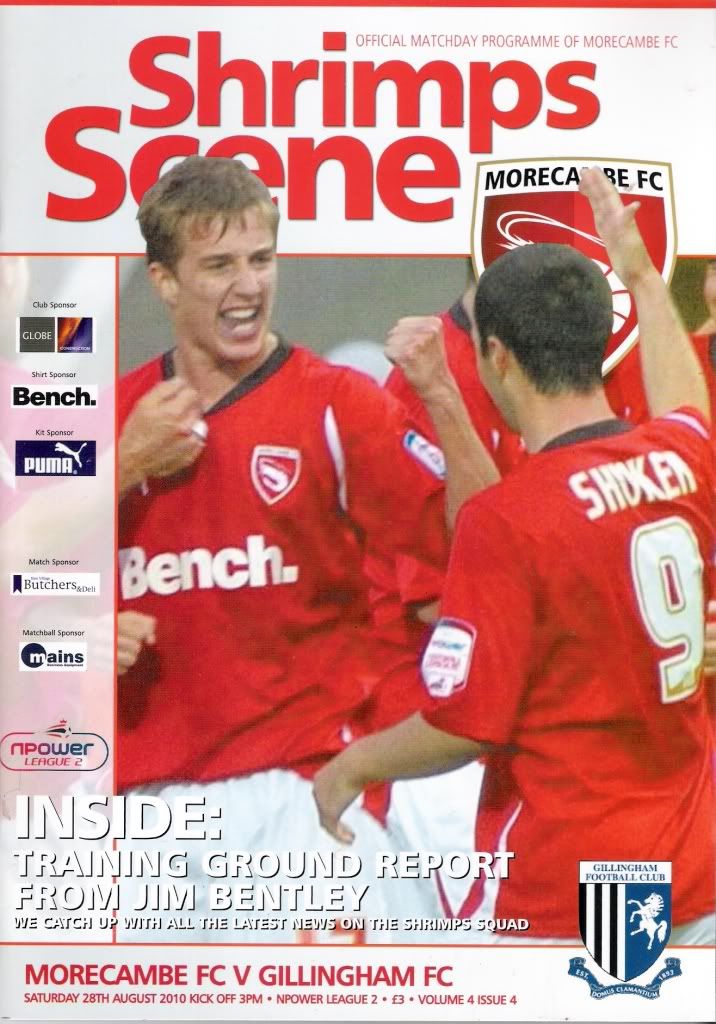
My Matchday - 261 Globe Arena

Morecambe 1v1 Gillingham
League Two
Saturday 28th August 2010
Morecambe was a favoured holiday destination when I was a bairn, and I don’t mean the ill fated The World of Crinkley Bottom attraction in Happy Mount Park.
I fondly remember spending a few summers in the late 1970’s boarding the coach at Gallowgate bus station with my Mam & Dad and sister Gillian on route to Pontins at Middleton Tower.
The holiday camp was based around a huge building in the style of an ocean liner built in the centre of a large lake. I don’t look back with much nostalgia at these holidays. I spent most of the week suffering from asthma due to the thick woollen blankets in the chalets, sprouting a face full of spots due to the overcooked fried bread breakfasts and having no money left by Sunday after blowing my pocket money in the amusement arcade.
After 30 years apart, I’ve frequently returned to this Lancashire seaside town over the past two years. My last visit for football reasons was early in 2009 when ticking off Christie Park, for a League Two clash with Gillingham, so for my latest return to visit the town’s spanking new stadium, Morecambe again faced The Gills for the first time since that fixture took place.
Going into kick off both teams were without a league win between them this season and come the final whistle that unwanted record remained intact, both having to settle for a share of the points.
Gills were the dominant side in the first half, Shrimps skipper Barry Roche keeping his team in the game, pulling off a string of fine saves to twice deny danger man Barcham and producing a splendid double save from Bentley and Spiller.
Morecambe improved in the second half and after a lively start took the lead just before the hour mark. Craig Stanley got on the end of a Mark Duffy cross with a free header from 12 yards.
Gillingham made a double substitution with a quarter of an hour remaining and finished the game strongly. Danny Spiller grabbed the equaliser on 83 minutes, getting on the end of a Palmer free kick to score from a tight angle at the far post.
Spiller wasted a golden opportunity to win the game, blazing over from 12 yards and Roche again denied Barcham with another great save to earn his side a well earned point.

The Globe Arena cost around £12m and is built by Globe Construction, who claim the naming rights having agreed a £250,000 five year sponsorship deal.
After 89 years at Christie Park, work on the 6,476 capacity stadium began in May 2009, a year later than originally planned due to delays with planning, sales and legal agreements. The construction of the Main Stand began in September 2009 with the other three stands developed at the turn of the year.
After a bit of a false start with all three pre-season fixtures postponed, the stadium opened in time for Morecambe first competitive home match of the season against Coventry City in the 1st Round of the Carling Cup on August 10th. The occasion was marked with a 2-0 win with the honour of the first goals at the Arena scored by Andy Fleming.

The Main Stand has a capacity of 2,173 and is named after chairman Peter McGuigan, in recognition of his 10 years in charge of the club.
The stand has all the facilities which the club previously lacked with five private boxes, sponsors lounges, sizable press area and a large hospitality suite which isn’t just used on match day but throughout the year.
The stand runs pitch length, decked out in gleaming white seats with a red section in the centre which is in front of the hospitality and private boxes.
There are covered terraces behind each goal. The West Stand is called the MBW Stand, named after the local wine business and holds 2,234 home spectators, with two disabled sections situated at the front.
The opposite stand is slightly smaller, set further back with the bottom of the terrace parallel with the crossbar. The East Terrace is known as The Bay Radio Stand and accommodates 1,389 visiting fans.
The Main Stand looks across to the Open Terrace which is an uncovered standing section which is reminiscent of the old Car Wash Stand at Christie Park. The 606 capacity terrace is split into two sections with a refreshment area and TV gantry block in between, as well as a large community block in the north east corner.
I headed up to Morecambe via the M6 from the Smudgers bank holiday weekend base in the outskirts of Blackpool. On arrival after a quick look at the ground I met up with 100FgC squad#155 James Little for a pre match drink at the William Mitchell pub, which is only a ten minute walk from the stadium and has a good selection of ales and also allows free use of their car park.
Edinburgh based James had already visited the Globe Arena for the Carling Cup tie with Coventry City. His description of the new ground was “An upmarket version of what they used to have”
A few more of the 100FgC squad got in touch prior to my impending visit to give their opinions, having attended last Tuesday’s clash with Burnley in the Carling Cup.
#86.Jim Morris described it as “A great day out with friendly stewarding, motorbike parking and photos allowed”
#83.Ralph Pomeroy added “Not bad for a new one .. its very much like an updated Christie Park” while one of our newest members of the squad #161.Micheal Swaffield said “We all thought that the Shrimps had replicated what they had before, although the main stand did look more modern! See if you spot the floodlight at the away end that looks out of position!
So the general consensus amongst the squad seemingly suggests that Morecambe have produced a modern day version of Christie Park, however I have read of issues concerning the restricted view in the Main Stand and the width of the alleyways, so I will be interested to read other reviews to subsequent visitors to the stadium.

I’d like to thank Morecambe for their hospitality, especially Derek Quinn for making me feel welcome. He told me to enjoy myself and to “Be nice to us” in my report. But how could I be unkind to such a friendly and hospitable club such as Morecambe? The club, players and their fans seem to have taking to their new surroundings like a duck to water (Shouldn’t that be Shrimp to water…Eddy) so I’d like to wish them all the best in their 21st century version of Christie Park.


Matchday stats
MFC 1(Stanley 59)GFC 1(Spiller 83)
att.2,325
Admission (PP)
seats:£16-£22 standing:£13-£15