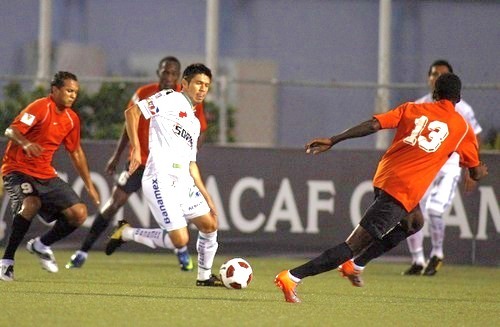
Ciertamente no fue el mejor juego, de hecho, la primera parte casi me quedo dormido, pero para la segunda, nuevamente vimos como un equipo "B" de Santos, pasaba por encima de un equipo Trinitario que se dedico mas a dar patadas que a plantarse como rival.
Santos Laguna solo hizo lo necesario --no mas-- para traerse una magra victoria de visita, en un partido que se distinguió por las pifias al frente de Oribe Peralta que aun viene con la mira chueca de la pretemporada, pero no fue el unico, Morales tuvo otro en sus botines que mando tristemente por arriba del travesaño y despues de eso, Pony Ruiz estrello otro balon por fuera de las redes.
Parecía que quedarian 0-0 y se les veía conformes a los de la Comarca, sin embargo, fue tanta la insistencia hasta que Pony Ruiz remató un balon dejado ahí en area chica, para el 0-1 definitivo y con esto, sumar su segunda victoria consecutiva, en un torneo oficial.
Créanme que no sabía que postear, y es que en honor a la verdad, hubiera resultado un resumen mas interesante algún juego de la liga nocturna en la deportiva Torreón jajaja, pero bueno, esta es la zona que nos tocó vivir, y hay que jugar un torneo molero y bananero como este para acceder a un torneo de prestigio internacional como lo es el Mundial De Clubes.
Santos demuestra que quiere ir por todas las canicas, ojala se dé, su amplio plantel le da el lujo de partir el equipo y aun así tener hasta 5 ocasiones claras de gol y otras mas anuladas por supuestos fuera de lugar pitados por el arbitro que lo deben haber agarrado de cualquier liga llanera de aquel país.
Ahora, tocará a los trinitarios pagar la visita en el TSM, con desventaja, y a Santos, le toca rematarlos aquí, en lo que será un buen partido de interescuadras y un motivo para asistir estas vacaciones junto con los parientes que han llegado de lejos al Bello Estadio que tenemos y presumirlo como se merece ( ya que es lo unico que nos queda, antes presumíamos la tranquilidad de la región, pero esa ya hace mucho que nos la quitaron. ).
Sale!!
Wednesday, July 28, 2010
Fremantle United (Australia)
Those of us of a certain age will remember a more innocent time before lottery draws and online gaming, when the only chance you had of having a gamble was either going down the fag encrusted bookies, or filling in the football pools. And what did the pools do in the summer when the English league was off on their holls? It headed for Australia! All through the summer months I'd study the strange names on my old mum's Aussie Pools paper. Exotic sounding places like Geelong, Noarlunga and Wanneroo rubbed shoulders with more familiar sounding teams like South Adelaide, Sunbury and Bayswater. But no one ever wondered who played for these teams, let alone what their kit looked like.
So I was happily surprised when I found out that the old Aussie pools stalwarts Fremantle United were among the bestriped bretheren - my curiosity was pricked and I had to discover more. Regulars in the Western Australia League, they've been more than just a name on an English coupon since 1977. Known simply as Freo to their many fans and players, they soon grew to become one of the most successful sides in Western Australia. Since 1985 they've bagged eight WA Amateur Premier League titles, six runners up slots, and a couple of Division One titles.
But they're a club with the local area at heart too, running a stable of 26 youth sides, at all ages and abilities at their Carrington Street ground in the Beaconsfield suburb of the city of Fremantle. This has obviously paid off, as not only are they one of the most winningest sides in the state, but many of their players have gone on to the Australian professional game and beyond.
So if ever you see an Australian Pools coupon again - and who knows, they might just come back into fashion, spare a thought for all those funny sounding teams with a row of tick boxes alongside them. They might just be a bunch of random names to you, but every one of them is at the heart of a living and breathing community.
All photos © lays with the owners
Videos from YouTube. Underlying © lays with the owners of the clips.
So I was happily surprised when I found out that the old Aussie pools stalwarts Fremantle United were among the bestriped bretheren - my curiosity was pricked and I had to discover more. Regulars in the Western Australia League, they've been more than just a name on an English coupon since 1977. Known simply as Freo to their many fans and players, they soon grew to become one of the most successful sides in Western Australia. Since 1985 they've bagged eight WA Amateur Premier League titles, six runners up slots, and a couple of Division One titles.
But they're a club with the local area at heart too, running a stable of 26 youth sides, at all ages and abilities at their Carrington Street ground in the Beaconsfield suburb of the city of Fremantle. This has obviously paid off, as not only are they one of the most winningest sides in the state, but many of their players have gone on to the Australian professional game and beyond.
So if ever you see an Australian Pools coupon again - and who knows, they might just come back into fashion, spare a thought for all those funny sounding teams with a row of tick boxes alongside them. They might just be a bunch of random names to you, but every one of them is at the heart of a living and breathing community.
All photos © lays with the owners
Videos from YouTube. Underlying © lays with the owners of the clips.
Corby Town (England)
Corby Town hail from the Northamptonshire steel town of the same name, and first kicked a ball under that name in 1948. However, the works side of the Stewarts & Lloyds steel factory played in the United Counties League from at least the early 1930s, and were thought to be the basis on which Corby Town were formed. The club's nickname, The Steelmen, pays testament to this possibility.
There's is a history of slow but steady progress up the leagues. Two UCL titles in the fifties saw them invited to the Midland Football League, and it was five years later that their Occupation Road ground saw Southern League action - at that time the very top of the non-league tree. Indeed, they applied for election to the Football league on a number of occasions, but were clearly never successful. After a spell of non-league reoganisation saw the Southern League lose its seniority, Corby stayed in one or other of their divisions until 2009, when they battled their way to win the unfeasibly massive Southern League trophy and get themselves into the Blue Square North - the second tier of non-league football.
Along the way they had a change of ground, and Occupation Road made way for the all-purpose sports ground at the council-owned Rockingham Triangle in 1985. Famous former players include Mark Lawrenson, who spent a season there towards the end of his career, West Ham striker Trevor Morley, who started his career there, and the free-scoring and much travelled Dixie McNeil, who currently manages fellow stripes Cefn Druids in Wales.
The club are famous for the self- mocking humour of their fans. A huge number of local residents came down from Scotland to work in the steelmills of Corby, so they often refer to themselves as The Plastic Jocks, and sing songs about ASBOs, poor diets and nicking hubcaps to get the jokes in before their rival fans do. To that end it's always a pleasure to share a game with them, so if they're ever playing around your way, make sure you pay them a visit.
All photos © lays with the owners
Videos from YouTube. Underlying © lays with the owners of the clips.
There's is a history of slow but steady progress up the leagues. Two UCL titles in the fifties saw them invited to the Midland Football League, and it was five years later that their Occupation Road ground saw Southern League action - at that time the very top of the non-league tree. Indeed, they applied for election to the Football league on a number of occasions, but were clearly never successful. After a spell of non-league reoganisation saw the Southern League lose its seniority, Corby stayed in one or other of their divisions until 2009, when they battled their way to win the unfeasibly massive Southern League trophy and get themselves into the Blue Square North - the second tier of non-league football.
Along the way they had a change of ground, and Occupation Road made way for the all-purpose sports ground at the council-owned Rockingham Triangle in 1985. Famous former players include Mark Lawrenson, who spent a season there towards the end of his career, West Ham striker Trevor Morley, who started his career there, and the free-scoring and much travelled Dixie McNeil, who currently manages fellow stripes Cefn Druids in Wales.
The club are famous for the self- mocking humour of their fans. A huge number of local residents came down from Scotland to work in the steelmills of Corby, so they often refer to themselves as The Plastic Jocks, and sing songs about ASBOs, poor diets and nicking hubcaps to get the jokes in before their rival fans do. To that end it's always a pleasure to share a game with them, so if they're ever playing around your way, make sure you pay them a visit.
All photos © lays with the owners
Videos from YouTube. Underlying © lays with the owners of the clips.
VC Eendracht Aalst 2002 (Belgium)
Now here's another one of those clubs that play in black and white stripes - but not entirely as you might imagine. Eendracht Aalst are the historic successors to a team called K.S.C. Eendracht Aalst, from the Flanders town of Aalst, who went out of business in 2002. They play at the same ground to the same fans, so in effect are the same club in all but name. They used to be top flight regulars, but after their bankruptcy were required to start all over again in the third tier, and since then have frequently bounced up and down between there and the second division.

The original club formed in 1919, by veterans of the First World War. Their most notorious year though was in the 1961/62 season when part way though a niggly game against Standard Liege resulted in an on-the- pitch punch up between players - which led in turn to a full-scale riot that resulted in the game being abandoned. The club were forced to play some games behind closed doors, many players were suspended for many games, and the club's physical coach was banned from operating for 12 months. The club never recovered and finished bottom that season - taking them another 29 years to get back to the top flight. Has one mad game ever led to such a long-term downfall?
However, by the 1990s they recovered to such an extent that a fourth- place finish in the premier league led them to a small foray into Europe in 1995, where after beating Levski Sofia in the first round they got battered by Roma in the next. Their only other laurels have been two second division championship titles.
They play at the 7000 capacity Pierre Cornelisstadion, and go by the lovely nickname De Ajuinen - Dutch for The Onions. This carries through to their rather unlikely mascot, who appears to be a massive stripy black and white clove of garlic. As far as their strip goes, although frequently flirting with a more traditional striped kit, they currently play in a strange kit with two bold stripes down one side - although we're quite sure that this is only a temporary measure and they'll try out every possible configuration of the famous kit in the future.
All photos © lays with the owners
Videos from YouTube. Underlying © lays with the owners of the clips.

The original club formed in 1919, by veterans of the First World War. Their most notorious year though was in the 1961/62 season when part way though a niggly game against Standard Liege resulted in an on-the- pitch punch up between players - which led in turn to a full-scale riot that resulted in the game being abandoned. The club were forced to play some games behind closed doors, many players were suspended for many games, and the club's physical coach was banned from operating for 12 months. The club never recovered and finished bottom that season - taking them another 29 years to get back to the top flight. Has one mad game ever led to such a long-term downfall? However, by the 1990s they recovered to such an extent that a fourth- place finish in the premier league led them to a small foray into Europe in 1995, where after beating Levski Sofia in the first round they got battered by Roma in the next. Their only other laurels have been two second division championship titles.
They play at the 7000 capacity Pierre Cornelisstadion, and go by the lovely nickname De Ajuinen - Dutch for The Onions. This carries through to their rather unlikely mascot, who appears to be a massive stripy black and white clove of garlic. As far as their strip goes, although frequently flirting with a more traditional striped kit, they currently play in a strange kit with two bold stripes down one side - although we're quite sure that this is only a temporary measure and they'll try out every possible configuration of the famous kit in the future.
All photos © lays with the owners
Videos from YouTube. Underlying © lays with the owners of the clips.
Atherton Collieries AFC (England)
Atherton Collieries were created in 1916 in the small town of Atherton - halfway between Salford and Wigan - by a group of miners from the area's six pits, as a means to providing welfare and entertainment to the people who stayed back home to work on the war effort. Intrinsically linked to both the pits and the people who worked down them, the club was given to the people of the town when the mines were nationalised in 1946.
They currently play in the First Division of the North West Counties League - the tenth level of the English football pyramid. But don't think that this makes them a lowly team, as they have got a fine battling tradition in the local leagues of the Greater Manchester area. They've won the Bolton Combination ten times, and their six victories in the Lancashire FA Amateur Shield is a record that still stands to this day.
Variously dubbed The Colls, The Miners, and most cutely, Sooty, they play at the 2,500 capacity Alder Street stadium - much of it built with railway sleepers - and despite having an average gate of less than 100, their record attendance was in 2007, when FC United of Manchester, on their charge through the lower leagues, pumped the gate for their home game up to 1461 - more than doubling their average attendance for that season.
They have hit the new more recently, however, after the local FA compained about their new kit, claiming that it was too similar to the local ref's kit. So after 94 years of playing in the barcode stripes, they've been temporarily force to change their colours until another black and white strip can be found. The good thing though is that their offending kit - seen above - had been retired unbeaten, having played just one home league game and one home cup game in the strip!
All photos © lays with the owners
Videos from YouTube. Underlying © lays with the owners of the clips.
They currently play in the First Division of the North West Counties League - the tenth level of the English football pyramid. But don't think that this makes them a lowly team, as they have got a fine battling tradition in the local leagues of the Greater Manchester area. They've won the Bolton Combination ten times, and their six victories in the Lancashire FA Amateur Shield is a record that still stands to this day.
Variously dubbed The Colls, The Miners, and most cutely, Sooty, they play at the 2,500 capacity Alder Street stadium - much of it built with railway sleepers - and despite having an average gate of less than 100, their record attendance was in 2007, when FC United of Manchester, on their charge through the lower leagues, pumped the gate for their home game up to 1461 - more than doubling their average attendance for that season.
They have hit the new more recently, however, after the local FA compained about their new kit, claiming that it was too similar to the local ref's kit. So after 94 years of playing in the barcode stripes, they've been temporarily force to change their colours until another black and white strip can be found. The good thing though is that their offending kit - seen above - had been retired unbeaten, having played just one home league game and one home cup game in the strip!
All photos © lays with the owners
Videos from YouTube. Underlying © lays with the owners of the clips.
PHC Zebras (Bermuda)
The Zebras are an amateur football club based around the Pembroke Hamilton Club in Pembroke Parish in Bermuda. The original PHC started life as a yachting club way back in 1876. But it wasn't until 1960 that the club decided to broaden its horizons from being a mere drop-in sports club and move into other more active sports - and in particular become a major force in the island's football world.
They acquired the stadium in Warwick where they still play today, and merged with Key West Rangers, and set about prettying up their new ground - which until then had been used for motorcross, horse racing and as a golf driving range. It is said that their management team of that time was so distinguished that they could quite easily have run the country.
They play their football in the Bermuda Football Assoc Premier Division - the top flight in Bermudan football - where they play splendidly named teams like Boulevard Blazers, Devonshire Cougars and the current champions Dandy Town Hornets. They've won the national league nine times, the Bermuda Cup ten times, and in all have evidence of 39 trophies in the silverware cabinet.
Perhaps their two most famous old boys are former Stoke City cult hero Kyle Lightbourne, and the heaviest man ever to play in the cricket World Cup, the man mountain Dwayne 'Sluggo' Leverock - and when he tackled you, you stayed tackled for some days!
All photos © lays with the owners
Videos from YouTube. Underlying © lays with the owners of the clips.
They acquired the stadium in Warwick where they still play today, and merged with Key West Rangers, and set about prettying up their new ground - which until then had been used for motorcross, horse racing and as a golf driving range. It is said that their management team of that time was so distinguished that they could quite easily have run the country.
They play their football in the Bermuda Football Assoc Premier Division - the top flight in Bermudan football - where they play splendidly named teams like Boulevard Blazers, Devonshire Cougars and the current champions Dandy Town Hornets. They've won the national league nine times, the Bermuda Cup ten times, and in all have evidence of 39 trophies in the silverware cabinet.
Perhaps their two most famous old boys are former Stoke City cult hero Kyle Lightbourne, and the heaviest man ever to play in the cricket World Cup, the man mountain Dwayne 'Sluggo' Leverock - and when he tackled you, you stayed tackled for some days!
All photos © lays with the owners
Videos from YouTube. Underlying © lays with the owners of the clips.
Tuesday, July 27, 2010
Maidenhead United (England)
Those of you not up-to-speed with the glorious world of non-league football may still be aware of Maidenhead United - but not be entirely sure why. Well perhaps it's because the hold a couple of pretty spectacular records. Formed in 1870 as Maidenhead Football Club, they played their first game at their second home in York Road on 16 February 1871 against their life-long local rivals Marlow, where they have played continuously ever since. This makes theirs the oldest continuously used football ground in the world!
It was also apt that it was Marlow that they played in that first game, as the pair of them are tied in having played in the most FA Cup competitions - the oldest knockout tournament in the world - having each missed just the one year since it was first played back in 1871. This makes them the teams with the longest involvement in a single tournament in history! Most clubs don't get remotely close to having even one world record, so this little club from the middle-sized town in Berkshire is supremely blessed to have two!
York Road can squeeze 3000 into its quaint concretey enclosure, and its creaky old club houses and tea huts are among the best loved in the upper echelons of the non-league pyramid. Currently mid-table regulars in the Blue Square South - the sixth tier in English football - their pinacle of their footballing achievements was when they reached the semi-finals of the FA Cup - although that was back in its debut year when only 15 clubs had entered.
Things began to move along a little more when they merged with their less popular local rivals Maidenhead Norfolkians and first adopted the stripes in 1920, and called the new club first Maidenhead Town, and very soon after Maidenhead United, the name they have kept to this day. Despite York Road's thankfully small health and safety sensible crowd limit, their biggest gate was a massive 7989 when they played Southall in the quarter finals of the FA Amateur Cup in 1936 - and if any of you have ever lucky enough to have visited the place, you'll be at a loss to work out where they managed to put them all!
All photos © lays with the owners
Videos from YouTube. Underlying © lays with the owners of the clips.
It was also apt that it was Marlow that they played in that first game, as the pair of them are tied in having played in the most FA Cup competitions - the oldest knockout tournament in the world - having each missed just the one year since it was first played back in 1871. This makes them the teams with the longest involvement in a single tournament in history! Most clubs don't get remotely close to having even one world record, so this little club from the middle-sized town in Berkshire is supremely blessed to have two!
York Road can squeeze 3000 into its quaint concretey enclosure, and its creaky old club houses and tea huts are among the best loved in the upper echelons of the non-league pyramid. Currently mid-table regulars in the Blue Square South - the sixth tier in English football - their pinacle of their footballing achievements was when they reached the semi-finals of the FA Cup - although that was back in its debut year when only 15 clubs had entered.
Things began to move along a little more when they merged with their less popular local rivals Maidenhead Norfolkians and first adopted the stripes in 1920, and called the new club first Maidenhead Town, and very soon after Maidenhead United, the name they have kept to this day. Despite York Road's thankfully small health and safety sensible crowd limit, their biggest gate was a massive 7989 when they played Southall in the quarter finals of the FA Amateur Cup in 1936 - and if any of you have ever lucky enough to have visited the place, you'll be at a loss to work out where they managed to put them all!
All photos © lays with the owners
Videos from YouTube. Underlying © lays with the owners of the clips.
Subscribe to:
Posts (Atom)


